Most of us like to think of holidays like Thanksgiving and Christmas as dates full of joy, family warmth, and good food. Winter is supposed to be a beautiful show of lovely snowflakes everywhere. There is some kind of expectancy of staying cozy at home with our mug of hot chocolate, right? These days are supposed to be all about Christmas carols, family, and food.
Winter is not fun though. Light leaving us as soon as mid-afternoon is quite saddening. The cold, the blizzard, the layer after layer that isn’t able to keep us warm; the inclement weather, reminds us of our human limitations. If we were to consider the basic points of our physical needs, the absence of sun and, with it, of vitamin D will affect our mood directly, and might also affect our weight and pain in our bones and articulations. The well-known “seasonal depression” doesn’t come from nowhere.
Also, what does family time mean anyway? Where is our family? Many of the immigrants in the country are without their families around. Whether they are far, gone, lost, or simply uncommunicated. Have we been able to build our own family in the people we frequent, or are we just sitting down with ourselves, trying to forget sweet childhood memories, pushing away our desires to be near our loved ones, reminding ourselves over and over why we are making this effort? Or are we trying to forget bad past memories and stay away from people that, at some point, harm us?
During the COVID peak, we were all forced to stay home. The pandemic brought with it not just illness, and extended economic crises, but also time with ourselves. We were pushed and forced to look inside. To focus on ourselves and our families, and strive to survive under such circumstances. We face death and loss in a big range and promise to ourselves and others that given another chance we would make everything different and will be more mindful of our priorities.
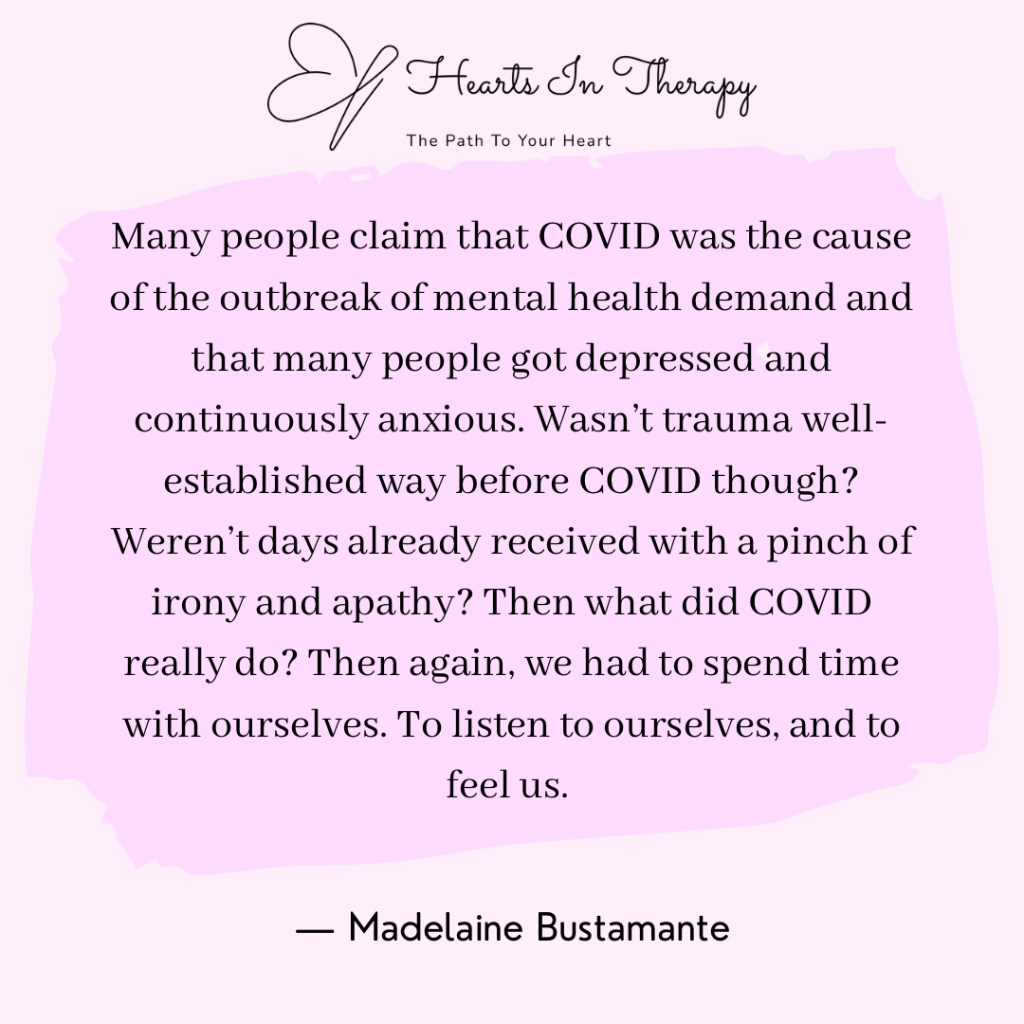
Many people claim that COVID was the cause of the outbreak of mental health demand and that many people got depressed and continuously anxious. Wasn’t trauma well-established way before COVID though? Weren’t days already received with a pinch of irony and apathy? Then what did COVID really do? Then again, we had to spend time with ourselves. To listen to ourselves, and to feel us. We couldn’t turn our faces to our jobs or to one and thousand activities we had to do. Because we had nothing to do other than kill time at home.
How do we look inside when it is so dark and cold? “Dark and cold? Oh, you must be kidding! I am full of happiness, colors, and cheerful music. Dark who? Cold where?” Then why were we feeling so down? Why was there an increase in people feeling so lonely and hopeless during that season? How come rather than enjoying the free time, we were desperately looking for things to go back to normal? Isn’t it similar to what we usually do during the holidays? Especially if they dare to last too long, leaving us too much time with ourselves.
To look inside is not an easy job. We do not have the tools to explore all that darkness. We were taught to smile, even when we are sad; to remain strong, even when we feel weak; to say everything is going well, even if things are falling apart. We were not told to face darkness, we were taught to run away from it; to keep a respectable distance from ours and others’ darkness.
There is a lot of talk about the new generations, the so-called “crystal” ones, about their apparent fragility, their constant cries, and their weakness. Why can’t they just stay quiet and bear with it? Why are they making such a big deal out of everything? Are they just lazy or crying babies? Are older generations truly stronger, and braver? Then what about generational trauma and mental health awareness? Is that also an invention of the crystal’s generation?
It is said that if we do not learn history we are doomed to repeat it. Then what do we know about it? We come from generations marked by the severity of armed conflicts and civil wars. Marked by genocides all over the world. Marked by poverty and fleeing from our homelands because staying and living weren’t synonyms anymore. Marked by discrimination, xenophobia, and homophobia. Marked by so-called religious wars and attacks in the name of religion. We fall short if we believe all these are matters of the past, isn’t all that happening again? Aren’t all these problems greeting us one more time and reminding us that we haven’t understood anything yet? How can we face the outside when our inside is full of cracks? How can we heal our insides when the outside seems so deprived?
We want to fight darkness with darkness because we are unsure about where light resides. We seem to walk blindfolded and wonder why we keep on stumbling on the same rock. We want to be able to offer the best to our loved ones, but we lack the resources to be our best versions because there are too many open wounds harming us. What should we do then? What alternatives do we have? There are many paths that might lead us to a better place, but I will mention one only. Not because the other paths are less efficient or worthy, but because my knowledge is even more limited in other spheres, therefore I will just talk about the one in which I have a decent amount of knowledge of Mental Health.
For some reason, it seems to be a common belief that mental health is something recent. We can say that advocacy for mental health is, kind of, recent; but mental health no. Maybe the problem might have to do with people’s fixation on minimizing mental health to psychiatric hospitals and psychotic disorders, not leaving space for anything else. The truth is that mental health has always existed, although maybe with less emphasis in daily life needs in the healthcare field at the beginning and with a focus on severe mental disorders.
If we go back in time, and use as an example religious or spiritual resources, we find in sacred texts, practices, and traditions the importance of reflection, spending time alone, being mindful, being caring, self-love, socialization, and more. From the beginning we are given the tools to face life and to learn how to behave; but as time passes by it gets harder to comply, even the simplest request for our well-being such as: sparing some time for ourselves.
Mental health then isn’t a specialization that addresses schizophrenia and paranoia, or bipolar and borderline personality disorders only; but also being sad, not finding meaning in life, having lost our motivation, feeling constantly worried, having recurrent nightmares, not being able to rest, and even feeling our hearts beating too fast lately without reason found in our lab analysis. Mental health can give us the opportunity to remember the tools we have within our scope, or even temporarily out of it, and also discover new ones.
To find ourselves in need to receive behavioral health services, which are within mental health, is nothing but acknowledging our humanity, and all that it involves. It is to recognize our fragility, but also our strength. It is about being able to ask for help considering we are all suffering, but we don’t always know how to manage it or how to cope with it. It is about breaking the chain of generational trauma and reclaiming in our hands our emotional wellness and, therefore, our peace and happiness.
Does that mean that Mental Health is the solution to all our problems then? No, of course not, that would be too ambitious and unrealistic. As much as I would love to offer the key to happiness, I can’t promise that much. Let’s put it this way, taking care of our mental health is learning to swim properly and having a breath of fresh air, while we swim in the waters of life because we all need to breathe.
ESPAÑOL:
En el frío y la oscuridad
A la mayoría de nosotros nos gusta pensar en los festivos como Día de Acción de Gracias y Navidad como fechas llenas de disfrute, calidez familiar y buena comida. Se supone que el invierno sea un hermoso show de agradables copos de nieves en todas partes. Hay un tipo de expectativa de estar calentito en casa con nuestra taza de chocolate caliente ¿Correcto? Estos días se supone que sean sobre canciones Navideñas, familia y comida.
Sin embargo, el invierno no es divertido; que la luz nos deje a media tarde es bastante entristecedor. El frío, la ventisca, la capa tras capa de ropa que no basta para mantenernos abriagos; las inclemencias del clima, recordandonos de nuestras limitaciones humanas. Si consideramos los puntos básicos de nuestras necesidades físicas, la ausencia de sol y, con esta, de vitamina D afectarán nuestro estado de ánimo directamente, podría afectar nuestro peso y dolores en nuestros huesos y articulaciones. La conocida “depresión de temporada” no viene de la nada.
Además ¿qué quiere decir tiempo en familia de todos modos? ¿Dónde está nuestra familia? Muchos de los inmigrantes en el país no tienen a su familia alrededor. Ya sea que estén lejos, se hayan ido, perdido, o simplemente incomunicado. ¿Hemos sido capaces de construir nuestra familia en la personas que frecuentamos, o nos estamos sentando con nosotros mismo, tratando de olvidar dulces recuerdos de infancia, apartando nuestros deseos de estar cerca de nuestros seres amados, recordandonos una y otra vez porqué estamos haciendo este esfuerzo? ¿O estamos tratando de olvidar esos malos recuerdos del pasado y alejaos de personas que, en algún punto, nos dañaron?
Durante la cumbre del COVID nos vimos forzados a quedarnos en casa. La pandemia trajo consigo no solo enfermedad, y una crisis económica extendida, pero también tiempo con nosotros mismos. Fuimos empujados y forzados a mirar dentro. A enfocarnos en nosotros mismo y en nuestras familias, y esforzarnos por sobrevivir bajo esas circunstancias. Enfretamos la muerte y la perdida a gran escala, y nos prometimos a nosotros mismos y a otros que si tuvieramos otra oportunidad haríamos todo diferente y seríamos más conscientes de nuestras prioridades.
Muchas personas aseguran que el COVID fue la causa del brote de demanda de salud mental, que muchas personas se deprimieron, y se angustiaron constantemente. ¿No estaba el trauma bien establecido mucho antes del COVID sin embargo? ¿No habían días recibidos con una pizca de ironía y apatía? Entonces ¿Qué fue lo que el COVID realmente hizo? Nuevamente, tuvimos que pasar tiempo con nosotros mismos. Ver dentro de nosotros y sentirnos. No podíamos girar la mirada hacía nuestros trabajos o a las una y mil actividades que teníamos que hacer. Porque no teníamos nada que hacer más que matar el tiempo en casa.
¿Cómo vemos dentro cuando está tan oscuro y frío? “¿Oscuro y frío? ¡Oh, debes estar bromeando! Yo estoy lleno de felicidad, colores, y música animada. ¿Oscuro quién? ¿Frío dónde?” Entonces ¿por qué nos estabamos tan tristes? ¿Por qué hubo un incremento de personas sintiendose solas y sin esperanza durante esa temporada? ¿Cómo así en vez de disfrutar el tiempo estabamos desesperados porque todo vuelva a la normalidad? ¿No es similar a lo que sentimos durante las festividades? Especialmente si se atreven a ser muy largas, dejandonos tiempo de más con nosotros mismos.
Mirar dentro de nosotros no es una tarea fácil. No tenemos las herramientas para explorar toda esa oscuridad. Nos enseñaron a sonreía, aun cuando estamos tristes; a mantenernos fuertes, aun cuando nos sentimos débiles; a decir que todo está bien, aun cuando las cosas se están desmoronando. No se nos dijo que enfrentemos la oscuridad, nos enseñaron a correr de ella; a mantener una distancia respetable de nuestra oscuridad y la de otros.
Se habla mucho de las nuevas generaciones, llamadas de “cristal”, de su aparente fragilidad, su constante llanto y debilidad. ¿Por qué no se quedan callados y aguantan? ¿Por qué están haciendo un gran problema de la nada por todo? ¿Son vagos o llorones? ¿Son las generaciones anteriores más fuertes y más valientes? ¿Entonces qué es esto del trauma generacional y el conocimiento de salud mental? ¿También son invenciones de la generación de cristal?
Se dice que si no aprendemos de historia estamos condenados a repetirla. Entonces ¿Qué sabemos al respecto? Venimos de generaciones marcadas por la severidad después de conflictos armados y guerras civiles. Marcadas por genocidios alrededor del mundo. Marcadas por la pobreza y la huída de nuestros países natales porque quedarse y vivir ya no eran sinónimos. Marcadas por las famosas guerras religiosas y ataques en el nombre de la religión. Nos quedamos cortos si creemos que todo esto son cosas del pasado ¿no está pasando todo de nuevo? ¿No están estos problemas saludandonos una vez más y recordandonos que no hemos entendido nada todavía? ¿Cómo podemos enfrentar el exterior cuando el interior está lleno de grietas? ¿Cómo podemos sanar el interior cuando el exterior parece tan carente?
Queremos pelear oscuridad con oscuridad, porque estamos inseguros sobre dónde reside la luz. Parece que caminamos con los ojos vendados y nos preguntamos por qué seguimos tropezando con la misma piedra. Queremos poder ofrecer lo mejor a nuestros seres amados, pero nos faltan los recursos para ser nuestra mejor versión porque hay demasiadas heridas abiertas lastimandonos. ¿Qué deberíamos hacer entonces? ¿Qué alternativas tenemos? Hay muchos caminos que podrían llevarnos a un mejor lugar, pero yo mencionaré una sola. No porque los demás caminos sean menos eficientes o dignos, sino porque mi conocimiento es incluso más limitado en otras esferas, por ende solo hablaré de la que tengo una cantidad decente de conocimiento, que es: Salud Mental.
Por alguna razón, pensar que la salud mental es algo reciente parece ser una creencia común. Podemos decir que la defensa de salud mental es, de alguna manera, reciente; pero no la salud mental. Tal vez el problema tenga que ver con la fijación de las personas en minimizar salud mental a hospitales psiquíatricos y desordenes psicóticos, sin dejar espacio para nada más. La verdad es que la salud mental siempre ha existido, aunque tal vez con menor énfasis en el diario vivir en el ámbito sanitario al principio, y con un enfoque en desordenes mentales severos.
Si volvemos en el tiempo, y usamos como ejemplo recursos religiosos o espirituales, encontramos en textos, prácticas y tradiciones sagradas la importancia de la reflexión, de pasar tiempo a solas, del cuidado, del amor propio, de la socialización, y más. Desde el principio nos fueron dadas las herramientas para enfrentar la vida y aprender cómo comportarnos; pero a medida que pasa el tiempo vuelve más y más difícil cumplir, incluso, el pedido más simple para nuestro bienestar como es: dejar algo de tiempo para nosotros mismos.
La salud mental entonces no es una especialización que aborda la esquizofrenia y la paranoia o el trastorno límite de la personalidad solamente; sino también el estar triste, no hallarle sentido a la vida, haber perdido la motivación, sentirse constantemente preocupado, tener pesadillas, no ser capaz de descansar, e incluso sentir que nuestro corazón está palpitando demasiado rápido últimamente sin razón encontrada en nuestros análisis de laboratorio. La salud mental nos puede dar la oportunidad de recordar las herramientas que tenemos dentro de nuestro alcance, o temporalmente fuera de este; y también descubrir nuevas.
Encontrarnos a nosotros mismos con la necesidad de recibir servicios de salud del comportamiento, que están dentro de salud mental, no es nada más que reconocer nuestra humanidad, y todo lo que esta involucra. Es admitir nuestra fragilidad, pero también nuestra fuerza. Es sobre ser capaz de pedir ayuda considerando que todos estamos sufriendo, pero no sabemos cómo manejarlo o cómo sobrellevarlo. Es sobre romper la cadena de trauma generacional y reclamar en nuestras manos nuestro bienestar emocional, y por ende, nuestra paz y felicidad.
¿Eso quiere decir que Salud Mental es la solución a todos nuestros problemas entonces? No, claro que no, eso sería demasiado ambicioso e irrealista. Aun cuando me encantaría ofrecer la llave de la felicidad, no puedo prometer eso. Pongamoslo de esta manera, cuidar de nuestra salud mental es aprender a nadar apropiadamente y tener una bocanada de aire fresco, mientras nadamos en las aguas de la vida porque todos necesitamos respirar.

 Hearts In Therapy